- Soma Mater's Newsletter
- Posts
- SOMA Newsletter
SOMA Newsletter
Soma Mater
December 22, 2025

Welcome to the SOMA MATER weekly newsletter.
At SOMA MATER, we specialize in delivering comprehensive research and advisory services with a focus on Food & Water Security and Net Zero Transition in the MENA Region. In order to support our subscribing clients in navigating these topics and understanding the regional narrative, we produce monthly Food and Water Security and Net Zero Transition Intelligence Reports, along with our in-depth analysis and insights.
This weekly newsletter highlights the top 3 stories from the past week in Food and Water Security and Net Zero transition, along with SOMA MATER's analysis and perspective.
How can water-efficient techniques restore desert ecosystems within the precipitation limits of the MENA region?
How is the GCC region addressing water scarcity through desalination, and what are the economic and environmental challenges involved?
What has been driving the demand for sustainable buildings in the UAE real estate market?
Sustainably yours,
The SOMA team
One Millimeter at a Time: The Al Baydha Project's Blueprint
#FoodandWaterSecurity

Neal Spackman's work on the Al Baydha Project (Saudi Arabia) from 2010-2017 is a blueprint for reversing desertification in the region. Working with settled Bedouin tribes, Spackman developed a system to use less water than the land naturally captured, employing water harvesting techniques. The extreme evaporation-to-precipitation ratio means a self-funding ROI could take 30 to 40 years. The project provides a replicable framework for the region.
The approach is built on 10 fundamental keys, starting with understanding whether a site is a natural desert or undergoing desertification—revealed through geological features. Second, mapping the complete water cycle, including extreme events like Albaydha's 3 years without rain. Third, recognizing that nutrient cycles are broken and termites and other burrowing creatures are possible solutions. Fourth, identifying the watershed niche in order to maximize "crop per drop." Fifth, understanding the precipitation-to-evaporation ratio (Albaydha had a 43:1 ratio). The goal is to flip this balance around.
Anti-evaporative measures are critical—10 centimeters of mulch reduces soil evaporation by 50%, regardless of mulch type. Species selection centers on trees as the ultimate anti-evaporative element (a sapling at Albaydha grew 8 inches during 18 months with no irrigation after being watered for 1 month). Timing is also crucial: earthworks should be completed in summer when flooding risk is minimal, and planting should happen before winter to avoid summer heat. Lastly, create microclimates and enable ecological succession through interconnected systems. Designs should use fractal patterns that allow microclimates to self-replicate. By 2015, new mushroom species appeared at Albaydha, signaling the site's transformation into a self-sustaining "upward spiral of life."
SOMA’s Perspective:
This demonstrates that reversing desertification in the MENA region is possible through natural systems. These 10 keys respect the extreme precipitation-to-evaporation ratios characteristic of our region while working within, rather than against, natural cycles. While the 30-40 year ROI timeline may challenge conventional investment frameworks, the long-term value lies in restoring intergenerational broken nutrient and water cycles.
Sources:
Desalination Domination: Inside the GCC's Quest to Quench the Desert
#FoodandWaterSecurity
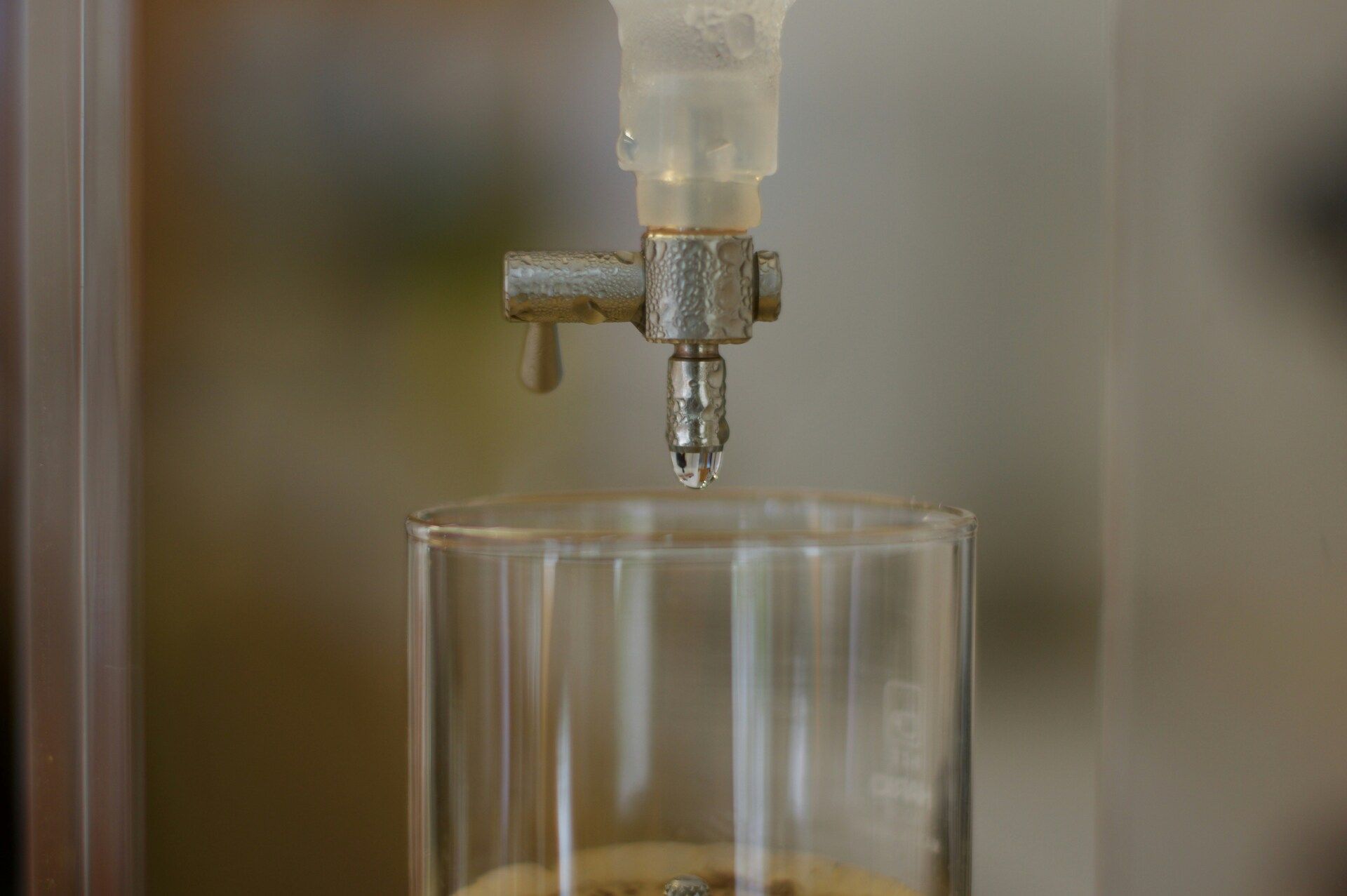
The GCC leads global desalination capacity, accounting for nearly 60% of worldwide capacity, with Saudi Arabia alone responsible for 22%. The Kingdom is expanding its infrastructure—projecting a 10% capacity increase to 17.8 million cubic meters per day by 2030. The Kingdom is expanding its infrastructure—projecting a 10% capacity increase to 17.8 million cubic meters per day by 2030. Yet with operational costs exceeding $0.50 per cubic meter and energy costs representing 40% of expenses, desalination economics remain challenging.
Saudi Arabia's recent partnership with Ebb Carbon marks the first large-scale effort to decarbonize desalination. Ebb's technology transforms brine into caustic soda, hydrochloric acid, and recyclable low-salinity brine. These chemicals, currently imported at significant cost, will now be produced locally. The technology also enables large-scale carbon removal—up to 85 megatons annually—by enhancing seawater alkalinity to permanently store CO₂.
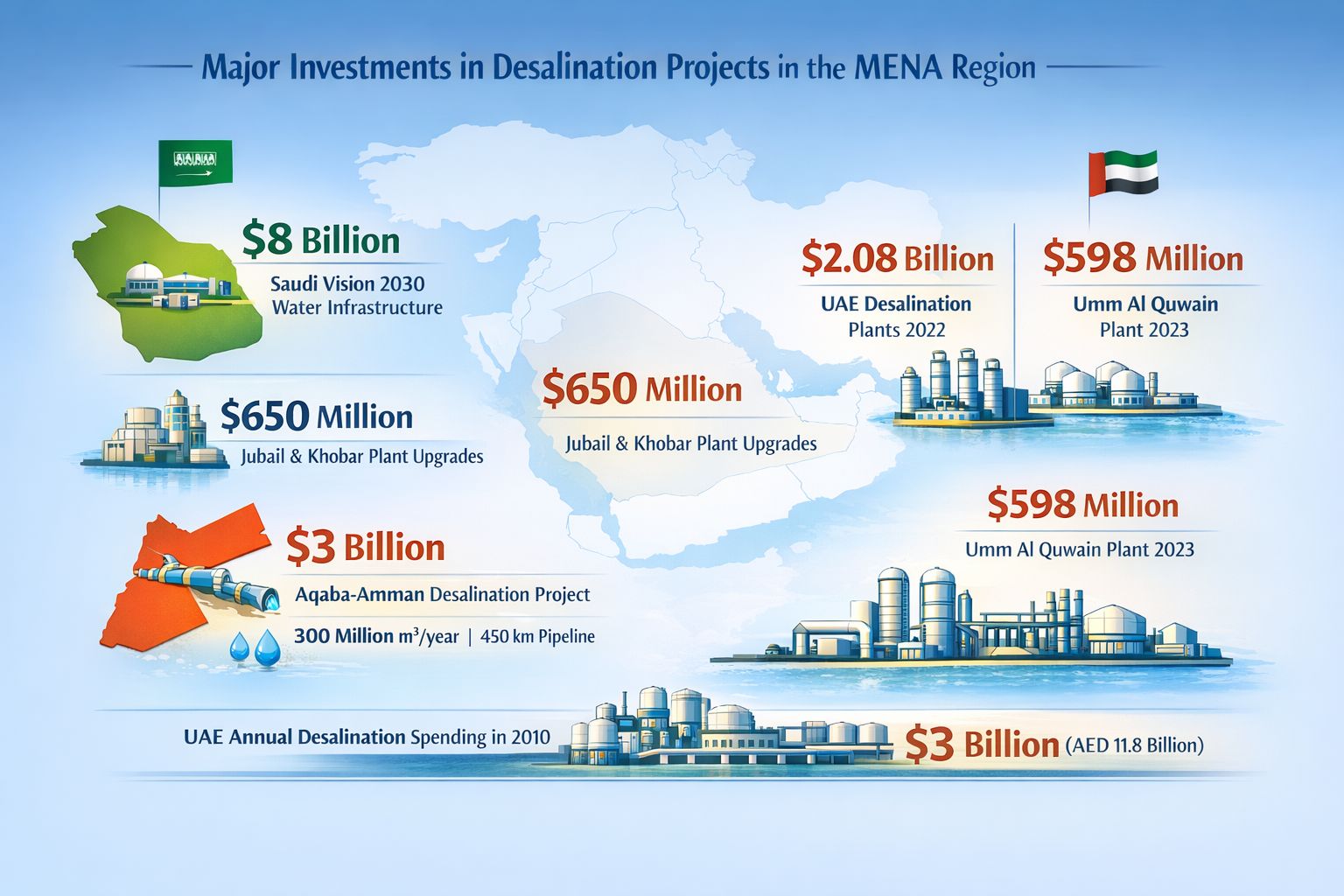
Regional investment demonstrates desalination's critical role (see figure for details). Saudi Arabia has committed over $8 billion to water infrastructure under Vision 2030, with the modernization of two desalination plants reaching $650 million. By 2010, the UAE spent nearly $3 billion annually on desalinated water. It invested $2.08 billion in new plants in 2022 alone, with a new $598 million desalination plant completed in Umm Al Quwain in 2023. Jordan is pursuing the $3 billion Aqaba-Amman project to deliver 300 million cubic meters annually by 2030. Experts caution infrastructure alone won't solve water scarcity—sustainable management requires supply improvement, demand management, ecosystem protection, and behavioral change.
Source: SOMA MATER research
SOMA’s Perspective:
The GCC has been experiencing a coordinated desalination infrastructure buildout. For many of these countries in arid climates, desalination is essential—and with the economic development they are pursuing, they need results now. However, it is also critical to invest in long-term nature-based management to avoid working against environmental gradients. As salt content in water rises, more energy is needed to extract the water.
Sources:
Build It Green and They Will Pay (More): Inside the Sustainable Real Estate Boom
#NetZeroTransition

The UAE's sustainable real estate sector is growing, with developers using advanced technologies and eco-friendly materials to meet demand. Green buildings cut energy use by 20–30% and water usage by up to 50%, while delivering 12–14% price premiums and rental premiums of up to 9% for residential properties—25-30% for commercial spaces. Over 5 years, green-certified commercial properties have appreciated by 45-55% versus 30-35% for traditional buildings.
The momentum is fueled by incentives: tax breaks, rebates for energy-efficient upgrades, and faster permissions for green-certified projects. HSBC UAE offers 0.25% interest rate discounts on green home mortgages. Sharjah provides no service maintenance fees for the first 5 years. As a result, 80% of UAE real estate investors and 70% of foreign investors are willing to pay premiums for eco-friendly properties.
By mid-2023, 72,000 Dubai buildings with Green Building Specifications had cut carbon emissions by 1.4 million tonnes. Dubai earned the Platinum LEED rating for Cities in 2021—the first in the Arab world and MENA—and exceeded its 16% emissions reduction target by achieving 22% by 2019. From Masdar City to Sharjah Sustainable City and BEEAH's Khalid Bin Sultan City, we are experiencing the redesign of sustainable urban living.
SOMA’s Perspective:
The UAE's green building momentum demonstrates that sustainability premiums are real and measurable. What distinguishes this buildout is the ecosystem alignment: government incentives, banking support, and developer commitment are converging rather than operating in silos. The 1.4 million tonnes of carbon emissions cut by 72,000 Dubai buildings shows that scale is achievable when regulatory frameworks and market incentives are properly calibrated.
Sources:
SOMA MATER is writing Intelligence Reports on the topics of Food and Water Security and Net Zero Transition. If you’d like to know more, contact us through the link below: