- Soma Mater's Newsletter
- Posts
- SOMA Newsletter
SOMA Newsletter
Soma Mater
October 13, 2025

Welcome to the SOMA MATER weekly newsletter.
At SOMA MATER, we specialize in delivering comprehensive research and advisory services with a focus on Food & Water Security and Net Zero Transition in the MENA Region. In order to support our subscribing clients in navigating these topics and understanding the regional narrative, we produce monthly Food and Water Security and Net Zero Transition Intelligence Reports, along with our in-depth analysis and insights.
This weekly newsletter highlights the top 3 stories from the past week in Food and Water Security and Net Zero transition, along with SOMA MATER's analysis and perspective.
How does the GCC Railway highlight the importance of integrated cold chain logistics?
How is the UAE leveraging AI to address water scarcity through cloud seeding technology?
How is Saudi Arabia addressing wildfire management in collaboration with the Food and Agriculture Organization (FAO)?
Sustainably yours,
The SOMA team
Cold Chains, Hot Connections: The GCC Railway's Journey
#NetZeroTransition #FoodandWaterSecurity
The GCC Railway, set for completion by December 2030, will connect all six Gulf Cooperation Council member states across 2,177km of track (Figure 1). Beyond slashing travel times, it promises to reshape regional trade and investment flows. Yet the real challenge lies not in laying rails, but in harmonizing the complex web of customs, immigration, and regulatory frameworks that will determine how goods and people move seamlessly.
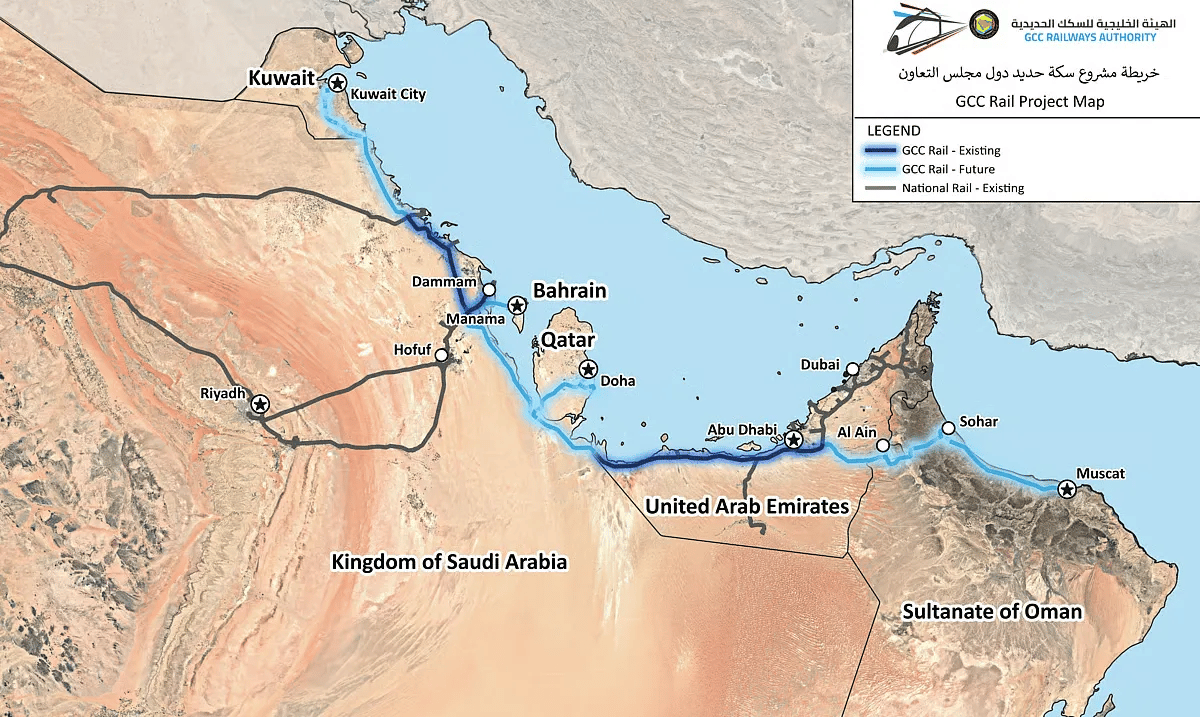
Figure 1: Map of the existing network, and the future rail to be added, according to the GCC Railway website
The railway's role in food logistics reveals a crucial intersection of infrastructure and climate impact. In 2022, indirect emissions from energy use in cold chains were more than double the direct emissions from refrigerants. Refrigerated railcars, now using HFC-134a refrigerants, and intermodal containers that can shift between rail, road, and sea transport offer the flexibility modern supply chains demand.
Saudi Arabia's strategic push illustrates this vision in practice. The Kingdom's Minister of Industry recently explored partnerships with Vietnam—home to integrated food manufacturing systems and major rice exporters—specifically targeting joint transport and storage solutions. Discussions with Vinafood II centered on developing integrated cold chain and logistics infrastructure, transferring expertise to establish advanced grain logistics centers in Saudi Arabia.
SOMA’s Perspective:
As the GCC Railway takes shape, its potential represents a recalibration of regional food logistics. The convergence of rail infrastructure, cold chain technology, and international partnerships signals to how we move (and cool) food matters. The real test will be whether member states can align their customs, immigration, and regulatory systems to enable seamless cross-border movement of goods. The region has shown it can mobilize capital and ambition—now it needs to build the coordination systems that turn infrastructure into connectivity.
Sources:
https://www.khaleejtimes.com/uae/transport/gcc-railway-set-for-completion-december-2030?__sta=vhg.blmsvsvhqxgv|IFFTQJI&__stm_medium=email&__stm_source=smartech&utm_campaign=Daily Newsletter&utm_content=&utm_medium=Email&utm_source=Netcore
Cloudy with a Chance of AI: How the UAE is Making It Rain Smart
#FoodandWaterSecurity

A UAE-backed research initiative is bringing artificial intelligence to cloud seeding. Funded by the UAE Research Program for Rain Enhancement Science, the project has reached a crucial milestone: the first customized WRF-SBM cloud-scale simulation over the UAE, run on the National Center of Meteorology (NCM)'s supercomputer 'Atmosphere.' The system uses advanced modeling to assess which clouds are worth seeding in near real-time, calculating the size distribution of water drops, ice crystals, and other particles to predict results.
The collaboration spans continents—Professor Daniel Rosenfeld from Hebrew University leads the effort alongside teams from Mohamed bin Zayed University of Artificial Intelligence, Wuhan University, and UC San Diego. It's part of a broader UAE push to position AI at the center of problem-solving, from water security to governance. Mohamed Bin Zayed University of Artificial Intelligence (MBZUAI) recently awarded its first honorary doctorate to OpenAI's Sam Altman.
The UAE's AI strategy extends beyond research into systemic integration across government, education, and industry. The country has introduced AI into public school curricula starting from kindergarten, launched an AI-powered office to harmonize federal and local laws, and created the "AI adoption seal" to incentivize companies incorporating AI into their operations—giving them competitive advantages in major government projects. This goes beyond a response to water scarcity—it's a template for weaving emerging technologies into national infrastructure.
SOMA’s Perspective:
The UAE's approach demonstrates both ambition and pragmatism: leveraging AI to address critical challenges like water scarcity while simultaneously grappling with the resource intensity of the technology itself. What distinguishes the Gulf's AI trajectory is the convergence of political will, capital availability, and energy abundance. The UAE's partnership with US AI companies (backed by over $90 billion in commitments) and Saudi Arabia's establishment of HUMAIN as a national AI champion signal more than investment—they represent a conviction that technological sovereignty will define competitive advantage in the coming decades.
Sources:
https://www.khaleejtimes.com/uae/openai-sam-altman-first-honorary-doctorate-mbzuai?__sta=vhg.blmsvsvhqxgv|IFFIQJI&__stm_medium=email&__stm_source=smartech&utm_campaign=Daily Newsletter&utm_content=&utm_medium=Email&utm_source=Netcore
Fanning the Flames (of Innovation): Saudi Arabia's Fiery New Approach to Forest Protection
#NetZeroTransition
The UN Food and Agriculture Organization's Near East Forestry and Range Commission convened in Jeddah for its 27th session, addressing the region's escalating wildfire crisis. Members endorsed a regional early warning system that integrates weather and vegetation data, while recommending continued Food and Agriculture Organization (FAO) support for national fire management strategies. The commission emphasized the urgent need for innovative solutions as droughts, extreme heatwaves, and prolonged dry spells intensify wildfire risks across North Africa and West Asia, threatening ecosystems, livelihoods, and food security while generating greenhouse gas emissions.
Saudi Arabia announced the Forest Ambassadors program in partnership with FAO, designed to empower entrepreneurs and volunteers in the environmental sector to lead forest protection and rangeland improvement efforts. Participating countries are invited to conduct investment opportunity assessments for forest and rangeland recovery, including economic feasibility analyses and scalable models that deliver sustainable environmental and social benefits.
Recent fire data reveals a complex picture for Saudi Arabia: 735 high-confidence VIIRS fire alerts were recorded between October 7, 2024 and October 6, 2025 (Figure 2)—a normal level compared to historical patterns since 2012. However, Al Qassim region has experienced an unusually high concentration of alerts in recent weeks, accounting for 12% of all detected fires with just 3 alerts in the last 4 weeks—a spike relative to historical data. Notably, the Kingdom has lost zero hectares of tree cover to fires from 2001 to 2024, with fire season spanning 52 weeks beginning in early January.
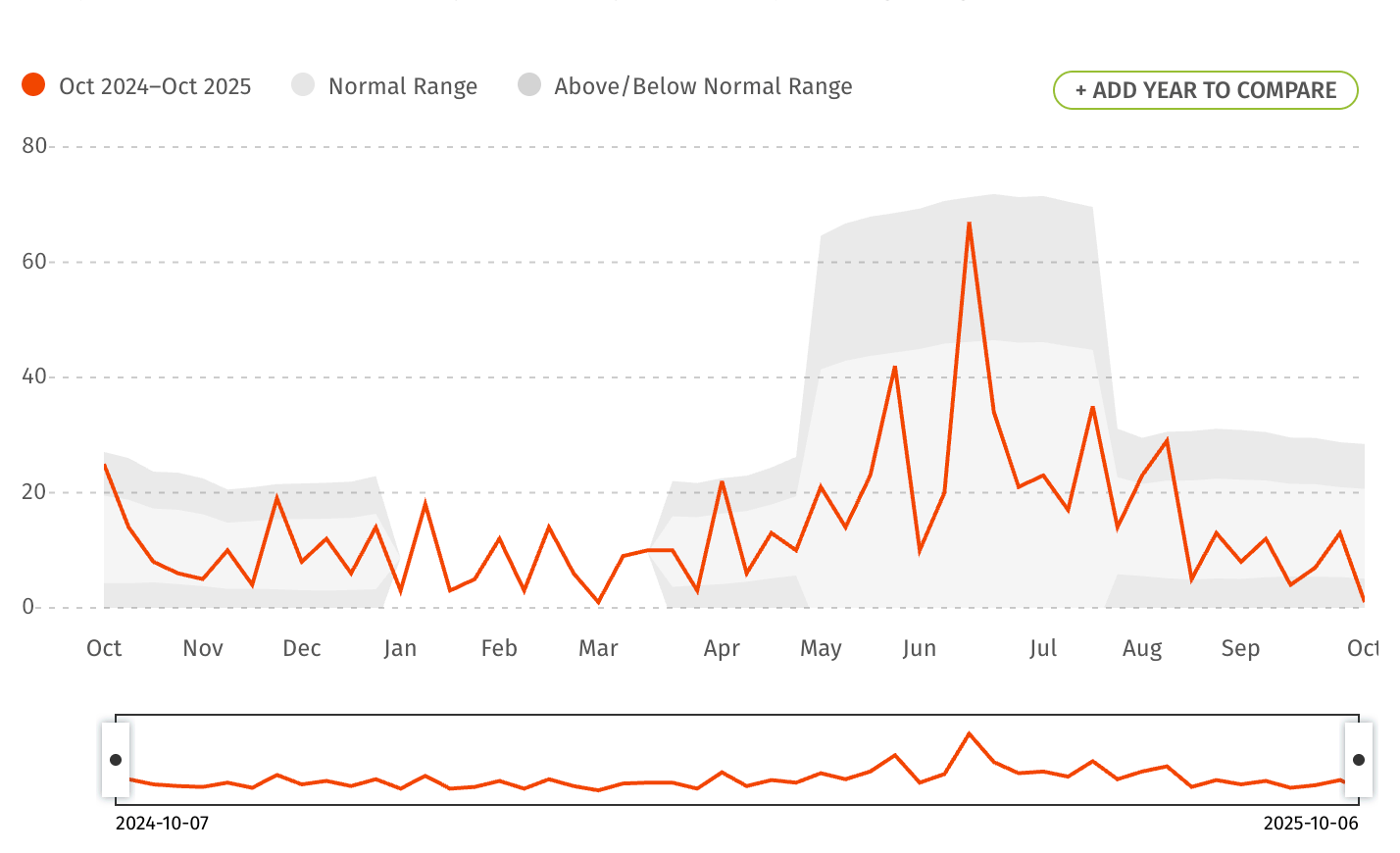
Figure 2
SOMA’s Perspective:
As Saudi Arabia expands forestry initiatives, data-driven warning systems will become ever more essential. Climate change is driving more frequent and intense extreme weather across MENA—between 2000 and 2024, the region saw hundreds of floods, heat waves, dust storms, and wildfires, with escalating severity. Wildfires have particularly surged, for example, with incidents in Syria's coastal region alone having burned over 30,000 hectares of agricultural and forest land, affecting at least 27,000 families through destroyed homes, lost livelihoods, and disrupted power and water supply.
Sources:
SOMA MATER is writing Intelligence Reports on the topics of Food and Water Security and Net Zero Transition. If you’d like to know more, contact us through the link below: