- Soma Mater's Newsletter
- Posts
- SOMA Newsletter
SOMA Newsletter
Soma Mater
December 08, 2025
Welcome to the SOMA MATER weekly newsletter.
At SOMA MATER, we specialize in delivering comprehensive research and advisory services with a focus on Food & Water Security and Net Zero Transition in the MENA Region. In order to support our subscribing clients in navigating these topics and understanding the regional narrative, we produce monthly Food and Water Security and Net Zero Transition Intelligence Reports, along with our in-depth analysis and insights.
This weekly newsletter highlights the top 3 stories from the past week in Food and Water Security and Net Zero transition, along with SOMA MATER's analysis and perspective.
What drivers are fueling the growing global food security crisis?
How did Sharjah's approach to greywater reuse policy evolve between 2003 and 2014, and what barriers limited its initial effectiveness?
What challenges and opportunities does Saudi Arabia face in scaling wastewater reuse to meet its 2030 targets?
Sustainably yours,
The SOMA team
The Billion Dollar Question: Can We Feed the World?
#FoodandWaterSecurity

The Food and Agriculture Organization and World Food Program identified 16 regions at growing risk of food crisis between November 2025 and May 2026: Afghanistan, Myanmar, Rohingya refugees in Bangladesh, South Sudan, Somalia, Kenya, Haiti, Sudan, Palestine, Yemen, Syrian Arab Republic, Democratic Republic of the Congo, Mali, Nigeria, Burkina Faso, and Chad.
Four drivers fuel this crisis: armed conflict destroys farmland and blocks aid access; economic instability drives up food prices and currency depreciation; climate change has become a structural threat—the Horn of Africa endured 5 consecutive failed rainy seasons; and funding shortfalls threaten response capacity, with WFP possibly facing only $6.4 billion in available funds. Figure 1 shows the number of people facing high food insecurity levels and humanitarian assistance allocated in USD billions.
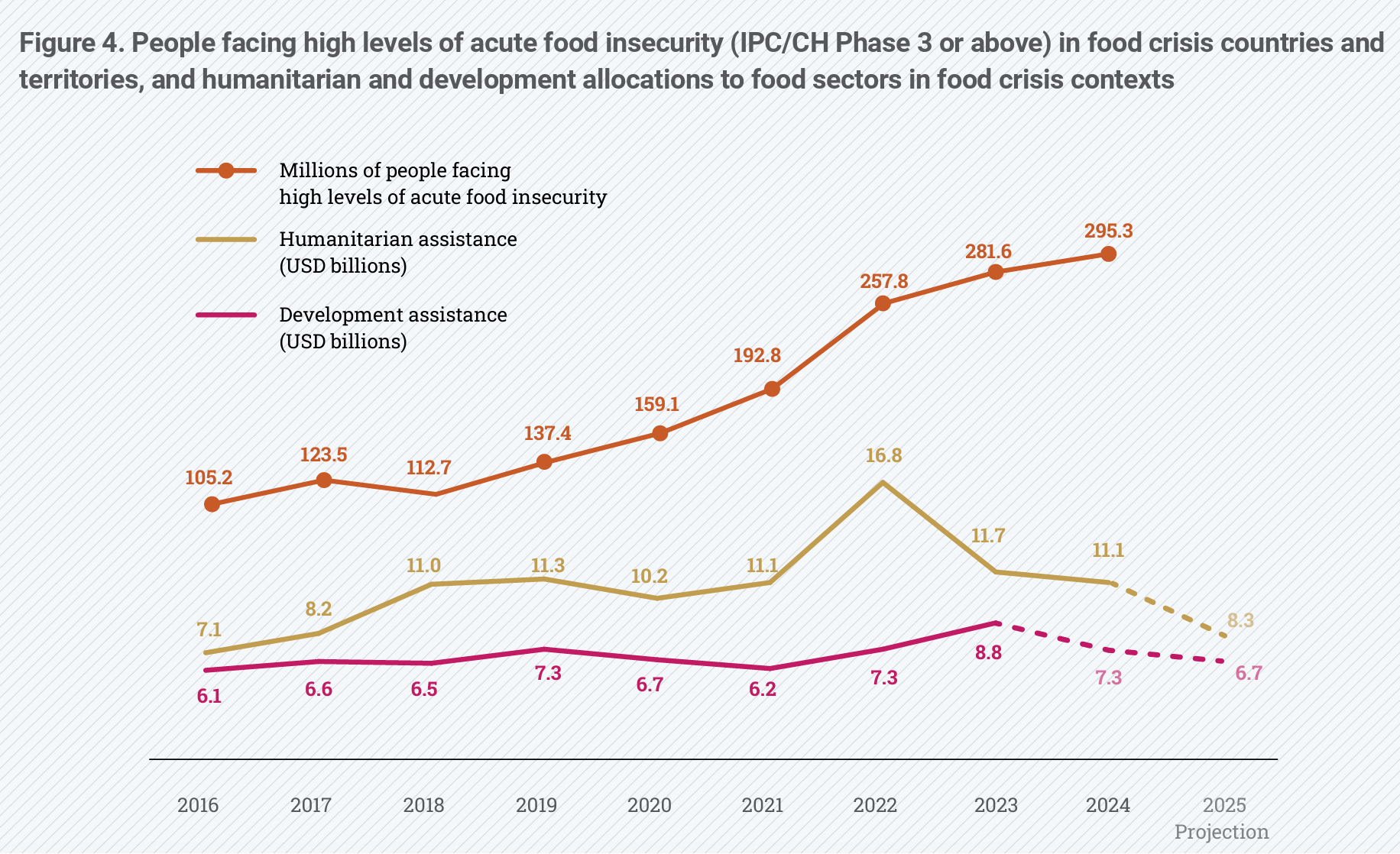
Figure 1
Earlier this year, SOMA created a similar diagram showing conflicts plotted alongside undernourishment in the MENA region (in millions) (Figure 2). Both figures reveal a similar pattern. Yet the window to prevent catastrophe remains open. Agricultural support on seeds, livestock health, and early action could stabilize food production and reduce emergency aid dependence. But this opportunity is rapidly closing, with most funding still addressing symptoms rather than root causes.

Figure 2
SOMA’s Perspective:
The research has shown that where violence persists, hunger follows. Given the geopolitical situation in the MENA region, a shift toward anticipatory (rather than reactive) investment in agricultural resilience is needed to prevent the gap between humanitarian need and available resources from widening further. The question is whether the response will evolve before that window closes entirely.
Sources:
Grey is the New Gold: Sharjah's Journey with Greywater Reuse
#FoodandWaterSecurity

Greywater (GW)—from showers, bathtubs, basins, and laundry—is emerging as a key unconventional water resource in urban areas. Sharjah's earliest greywater reuse (GWR) program, launched by Sharjah Electricity and Water Authority (SEWA) in 2003, faced community resistance, low awareness, economic disincentives, and limited monitoring. Reaching only 200 buildings with under 2% water savings, it prompted SEWA and the University of Sharjah to reassess.
A 12-month survey of 285,000 residents from 140 nationalities showed consumption ranging from 100-150 L/c/d in apartments to 200-610 L/c/d in villas, with GCC citizens consuming the highest at 610 L/c/d. This diversity highlighted the challenge of uniform GWR policies across culturally diverse populations.
In 2014, SEWA adopted a mixed compulsory/optional model. While GWR for toilet flushing proved burdensome for landlords, other successful installations achieved 25-40% water and cost savings. Progress remains limited by poor public understanding of greywater versus wastewater. SEWA applies uniform quality standards across all uses—irrigation, dust control, toilet flushing, HVAC cooling—though use-specific requirements could reduce costs.
SOMA’s Perspective:
Sharjah's greywater reuse journey shows that technical solutions require strong social and economic frameworks. Infrastructure alone fails when economic incentives misalign and public understanding lags. Sharjah's cultural diversity reveals a key insight: policymakers must consider the heterogeneous urban environments of the UAE. As regional water stress intensifies, religious and cultural factors must be addressed.
Sources:
Desert Flow: Saudi Arabia's Quest to Make Every Drop Count Twice
#FoodandWaterSecurity
Acea, Italy's leading water operator, signed a Memorandum of Understanding with Mowah, a Saudi water company, to bid on tenders for rehabilitating and operating wastewater treatment plants in Saudi Arabia. The partnership targets projects under the National Water Company (NWC), established in 2008, to modernize infrastructure, improve reuse rates, and support Vision 2030 goals.
Saudi Arabia treats over 6.5 million cubic meters of municipal wastewater daily but reuses only 25%, with 65% network coverage. Average per capita municipal water use rose from 227 L/d in 2009 to 270 L/d in 2016—3rd highest globally. The National Water Strategy targets 10 million cubic meters daily treatment capacity and 70% reuse by 2030. Despite being the world's largest desalination producer with 30% global capacity, desalinated water alone cannot meet demand, making wastewater reuse essential.
Much wastewater is still discharged unused. Current uses include agricultural irrigation, landscaping, and industrial purposes, with opportunities for aquifer recharge, groundwater enhancement, and district cooling. Key challenges include low collection coverage, limited treatment facilities, and need for capital investment.
SOMA’s Perspective:
This reflects the understanding that desalination is unlikely to sustain the MENA region's water future. Desalination leads to discharge that alters seawater parameters and affects marine ecosystems, while consuming significant fossil fuels. Though Saudi Arabia has among the world's lowest desalination costs due to cheap energy and large-scale facilities, desalinated water still costs 1.5 to 4 times more than traditional freshwater sources like lakes, rivers, and shallow wells. SOMA believes long-term investment in re-establishing natural water cycles (based on traditional freshwater resources) is a more sustainable approach for the region.
Sources:
https://mecouncil.org/publication/water-diplomacy-how-to-prevent-water-wars-in-the-mena-region/#:~:text=However%2C desalination is only a,river basins2 and aquifers.
SOMA MATER is writing Intelligence Reports on the topics of Food and Water Security and Net Zero Transition. If you’d like to know more, contact us through the link below: